 More data from the University of California, San Francisco in support of CAM in the care of cancer patients.
Continue reading Using massage and acupuncture to help control symptoms after cancer surgery
More data from the University of California, San Francisco in support of CAM in the care of cancer patients.
Continue reading Using massage and acupuncture to help control symptoms after cancer surgery
 The FDA is requiring stronger warning labels on 13 sedative-hypnotic sleep aids. In response, the makers of Ambien, Halcion, Lunesta, and Sonata are sending letters to healthcare providers this week discussing the new warnings. They will also develop educational handouts for patients who take these medicine.
So, what are the non-drug options for people with insomnia?
 An earlier entry cautioned about being overly enthusiastic about dehydroepiandrosterone (DHEA) as a miracle supplement. Now, we have evidence that it lacks any measurable anti-aging effect.
 Nicotine addiction has historically been one of the hardest addictions to break. So, anything that helps reduce cravings for a smoke is helpful.
Here’s what can be expected following an exercise session.
 “No Jet-Lag” is promoted as a “unique homeopathic remedy” that “offers a convenient solution to jet lag.”
There’s also a published study in Aviation, Space and Environment Medicine (1998, Vol 69, Issue 8) that supports its claims — or so the manufacturer states.
Continue reading “No Jet-Lag” and the elusive clinical trial
 Spending more than a day without Internet or cell phone access stresses me out. Therefore, I see it as complementary antianxiety therapy.
Last year, I spent 3 days being checked out in my local hospital. I complained about the lack of a cell to no avail.
Now, we have evidence from an impeccable source that debunks this silly rule.
Continue reading Cell phones don’t affect hospital equipment
 Meniere’s disease is characterized by deafness, ringing in the ears, dizziness, and nausea. Because the precise cause is unknown, most treatments are limited to treating symptoms.
Here’s a summary of CAM options from a review in The Internet Journal of Otorhinolaryngology.
Vertigo is a dizzying sensation of tilting or being in tilting or spinning surroundings.
Vertigoheel is a homeopathic product. It contains Ambra grisea, Anamirta cocculus, Conium maculatum, and Petroleum rectificatum.
Recently, a review of its effectiveness was published.
 Peripheral neuropathy is the most common neurological complication in HIV, and it’s often associated with antiretroviral therapy. Patients experience muscle weakness and atrophy, pain, and numbness.
Here’s what people use to manage the discomfort. Continue reading Self-care for peripheral neuropathy in HIV/AIDS
Fatigue and impaired daytime functioning, confusion, altered timing of bowel movements, and sleep disturbance are all signs of jet lag. An article on Medscape lists options to manage jet lag.
The article covers many treatment options. CAM options are listed here.
 Less than a month ago I summarized the results of a study where taking vitamin A was associated with increased risk of death. The significance of the results was debatable, but the headline was clear.
Now, researchers from the Karolinska Institute in Stockholm report “High intakes of vitamin A, retinol, and provitamin A carotenoids may reduce the risk of gastric cancer.”
Confused?
Continue reading Positive effect of vitamin A on cancer risk
 Here’s a report (see page 113) from the 2007 Multidisciplinary Head and Neck Cancer Symposium.
Researchers at the North Central Cancer Treatment Group (NCCTG) conducted a double-blind, placebo-controlled trial to determine the value of zinc in preventing taste alterations (dysgeusia) in patients with head and neck cancer who were undergoing radiation therapy.
Here are the details.
Although patients taking zinc had a delay in the onset of altered taste, the difference was not statistically significant. Therefore, the researchers concluded that zinc at the doses studied failed to prevent taste alterations in patients undergoing radiation-based treatment regimens for head and neck cancer.
The results differ from an earlier study in patients with dysgeusia that was not associated with cancer or other diseases.
3/10/07 14:42 JR
 A literature review by two researchers at York University in Toronto “suggest[s] that omega-3 PUFAs are an attractive adjunctive treatment for joint pain associated with rheumatoid arthritis, inflammatory bowel disease, and dysmenorrhea [painful menstruation].”
Results were positive for most measures of outcome.
Continue reading Evaluating omega-3 polyunsaturated fatty acid supplementation for joint pain
Researchers at Osher Institute at Harvard investigated the effectiveness and cost-of-care based on patients’ choice of acupuncture, chiropractic, or massage therapy compared with usual care to treat acute low back pain.
 Tai chi is a form of traditional Chinese exercise. Unlike the hard martial arts, tai chi is characterized by soft, slow, flowing movements that emphasize force rather than brute strength.
Now, a study in 47 adults claims that tai chi can have significant positive effects in people with tension-type headache.
 Agitation can influence the level of independence afforded to nursing home patients.
Here’s a study of the effectiveness of lavender (Lavandula angustifolia) in treating agitation in people with dementia.
Continue reading Using lavender to help control agitation in patients with dementia
 There is evidence for a protective role of vitamin E treatment in the prevention of heart disease. But is it for everyone?
This GISSI-Prevenzione study advises caution.
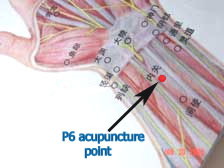 The Society for Ambulatory Anesthesia lists acupressure at the P6 meridian point (illustration) as an effective treatment for controlling nausea and vomiting following surgery.
Now, this study reports that patient-controlled acupressure helped control nausea and vomiting in patients receiving patient-controlled analgesia with morphine after gynecological surgery.
Continue reading Patient-controlled acupressure to treat nausea and vomiting after surgery
 Here is a large study conducted at 57 primary care clinics in the US and Europe. It shows that “in primary care, homeopathic treatment for acute respiratory and ear complaints was not inferior to conventional treatment.”
 In two studies