 Several years ago I wrote an article on the safety of acupuncture. I thought it worthwhile to see if any new reviews had been published.
Category Archives: Acupuncture/ pressure
Cost-effectiveness of spinal manipulation and acupuncture for low-back pain
 This review concludes that spinal manipulation and acupuncture are not cost-effective for low-back pain.
Here are the “money” quotes from this UK study.
Continue reading Cost-effectiveness of spinal manipulation and acupuncture for low-back pain
Acupuncture effective in fibromyalgia
 Fibromyalgia (FM) is a “chronic pain illness characterized by widespread musculoskeletal aches, pain and stiffness, soft tissue tenderness, general fatigue and sleep disturbances.” Approximately 3% to 6% of the U.S. population have FM, with women at greatest risk.
Successful treatment often requires combined therapies, and the results of this study in the The Mayo Clinic Proceedings support acupuncture in this regard.
Acupuncture: Effective and possibly cost effective in treating chronic neck pain
An earlier post summarized the Cochrane Collaboration’s positive assessment of acupuncture to treat chronic neck pain. Now, there’s additional support based on a study of more than 14,000 patients.
Continue reading Acupuncture: Effective and possibly cost effective in treating chronic neck pain
The growth of acupuncture and traditional Chinese medicine in North America
 Legislation has been submitted in Ontario, Canada to regulate acupuncture and traditional Chinese medicine. This is the culmination of an ongoing process that started in Canada in 1994. The proposed legislation would create a self-governing regulatory college, and restrict the practice of acupuncture to members of the profession who would be able to use title, doctor.
In North America, it’s the latest event in the growth of acupuncture, which was virtually unknown here until 1972 when China opened its doors to the West.
Continue reading The growth of acupuncture and traditional Chinese medicine in North America
Acupuncture in patients with osteoarthritis of the knee or hip
Ten years ago, Bandolier (the evidence based healthcare information service) stated that the best clinical studies “showed no difference between … acupuncture and sham acupuncture for pain relief.”
Since then, newer studies have been more positive.
Continue reading Acupuncture in patients with osteoarthritis of the knee or hip
Acupuncture for nausea and vomiting: where do we go from here?
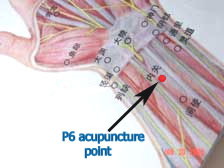 An earlier entry noted that updated guidelines for managing nausea and vomiting following surgery include acupuncture.
Five minutes of manual or electrical stimulation at the P6 acupuncture point (as shown in the illustration) is the primary point of treatment. Some supportive studies are listed here.
What issues remain to be address in clinical trials?
Continue reading Acupuncture for nausea and vomiting: where do we go from here?
Gum chewing vs acupressure wrist bracelet to shorten postcolectomy ileus
A surgical procedure called a colonectomy removes part or all of the large intestine. A common side effect of this surgery is known as postoperative ileus (POI) in which bowel movement is impaired following surgery and can take 48 to 72 hours to recover.
Common symptoms experienced by patients with POI include bloating, pain, nausea and vomiting, an inability to pass stools, and an inability to eat solid food. There is also a greater risk for other complications that can prolong the time they must stay in the hospital. This, of course, results in higher health care costs.
A recently published study of 66 patients was designed to determine the usefulness of gum chewing to shortening the time to recovery from POI.
Continue reading Gum chewing vs acupressure wrist bracelet to shorten postcolectomy ileus
Hot flashes: No sweat?
 Adriane Fugh-Berman, associate professor in the complementary medicine program at Georgetown University has chronicled the lack of good treatment alternatives for hot flashes.
Is acupuncture effective treatment for “hot flashes”?
When The Washington Post published an article (discussed here) reporting the negative results from a study of acupuncture and other CAM treatments for hot flashes, it elicited an international response in defense of CAM.
Continue reading Is acupuncture effective treatment for “hot flashes”?
Acupuncture not effective in perimenopausal women with hot flashes.
A recent study reported that self-acupuncture was associated with long-term relief of vasomotor symptoms (hot flushes) in patients with breast cancer or prostate cancer who are undergoing anticancer therapy.
Unfortunately, this does not seem to apply to women in perimenopause.
Here are the details of a recent study.
Continue reading Acupuncture not effective in perimenopausal women with hot flashes.
What to make of the conflicting results of acupuncture studies
Look at the list of posts on this site, and it becomes apparent that acupuncture has a problem showing that it’s effective treatment. People looking for any sign of effectiveness can conclude that acupuncture has a role in treating this or that disease, while those who are more skeptical — well, you know.
Can’t we all just get along?
Here is a suggestion that might help.
Continue reading What to make of the conflicting results of acupuncture studies
Self-acupuncture to control hot flushes in patients with breast and prostate cancer
Vasomotor symptoms can be extreme in patients with breast cancer or prostate cancer who are undergoing anticancer therapy. At the Royal Marsden Hospital in the U.K., an audit of 159 patients experiencing an average of 16 flushes per day revealed that self-acupuncture is associated with long-term relief of vasomotor symptoms in cancer patients.
Here’s a summary of the results
Continue reading Self-acupuncture to control hot flushes in patients with breast and prostate cancer
The long-term value of self-acupuncture for chronic musculoskeletal pain
Acupuncture is expensive, but self-acupuncture might offer an effective treatment alternative. A retrospective audit of patients in the U.K. with chronic pain who were taught self-acupuncture as a home pain management strategy has been published. Each patient had responded to acupuncture previously and been taught self-acupuncture successfully using three acupuncture points (LI4, ST44, LR3).
Here’s a summary or the results.
Continue reading The long-term value of self-acupuncture for chronic musculoskeletal pain
Acupuncture: Effectiveness and cost effectiveness for low back pain
Two studies published in the British Medical Journal provide a little more support for using acupuncture to treat chronic low back pain.
Continue reading Acupuncture: Effectiveness and cost effectiveness for low back pain
A primer on acupuncture
Since this blog started three months ago, more than a dozen posts have been about acupuncture.
Here is some basic information to know if you’re considering treatment by an acupuncturists. It comes from an article I wrote in 2000. Except for the conditions to treat, it’s still up-to-date.
- What is qi?
- Where is qi located in the body?
- Where are meridians located?
- What is the role of the acupoints?
- What about the other acupuncture points?
- How do the acupuncture needles create an electrical current?
- How does acupuncture actually work?
Plus some thoughts on safety.
9/9/06 10:55 JR
Is there a role for acupuncture in smoking cessation?
 A couple of weeks ago I posted general considerations for stopping smoking. A couple of hours ago I posted on exercise and smoking cessation. Let’s round out the topic with acupuncture and smoking cessation.
The bottom line. The literature does not support using acupuncture (or acupressure, laser therapy, and electrostimulation) in this way. There are just too many problems in the design and implementation of the studies to permit reliable conclusions.
The American Cancer Society agrees with this conclusion, but let’s look at one study reviewed by the American Cancer Society.
Continue reading Is there a role for acupuncture in smoking cessation?
Acupuncture to treat ADHD in a secondary school
“I have had acupuncture because I can get angry and I hate that feeling,” says Hannah (age 16 years), “you know, when you get really hot and out of control with your temper. I find it easier now to stay in control. I would tell anyone to have acupuncture if they have the chance.”
Continue reading Acupuncture to treat ADHD in a secondary school
Placebo versus placebo
A while ago I posted on a study that showed no difference in outcome between traditional Chinese acupuncture and sham acupuncture. Both interventions were a positive addition to physiotherapy and anti-inflammatory drugs.
Now, a study of sham acupuncture in adults with arm pain shows no difference compared to placebo tablets — neither worked.
But that’s just phase 1 of the study. Now it gets interesting.
Transitioning East Asian medicine to the West: An Asian perspective
 Giovanni Maciocia is Italian, not Chinese. Regardless, he is a respected practitioner of acupuncture and Chinese herbal medicine. And he has the ability to speak to westerns about Chinese medicine in a way that cuts through the mystique.
Three quotes from his book, “The Safety of Chinese Herbal Medicine” provide a different perspective than is typical among those who practice or are treated with Western medicine.
I make no judgment, right or wrong. It’s just different, and should be considered in any evaluation or critique.
Continue reading Transitioning East Asian medicine to the West: An Asian perspective