The results of the Advanced Cognitive Training for Independent and Vital Elderly (ACTIVE) study were summarized here recently.
Now, Dr. Sally Shumaker, professor of public health sciences and associate dean for research at Wake Forest University Medical School, writes about the study’s implications in the Journal of the American Medical Association.
The good news is that all 36 products tested had the claimed ingredients. But the doses varied from 15 mg to 400 mg!
This isn’t surprising and has been discussed here before. Perspective on the value of CoQ10 to treat high blood pressure, angina, and Alzheimer’s disease is provided in this earlier post.
“The main voices in favor of DHEA as a miracle drug are those who are selling it or who make a good living selling books or programs advocating ‘natural cures’.” That’s the conclusion from the Skeptics Dictionary. But look for yourself, and you will agree.
Here is another reason to be skeptical of DHEA [dehydroepiandrosterone].
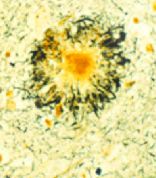
There is evidence that abnormal concentrations of positively-charged metal ions (eg, copper, iron, and zinc) interact with beta-amyloid in the brain during the development of Alzheimer’s disease. Therefore, correcting these abnormal levels might help people with this disease. (The photo shows yellow amyloid plaque surrounded by black neurofibrillary tangles.)
Two studies published this summer showed positive health effects of curry. One looked at brain function, the other at the colon.
First, the brain.
Mini-Mental State Examination (MMSE) scores were compared among 1010 elderly Asians, aged 60 to 93 years. The MMSE is used to determine the extent of dementia in adults. The results of the test were then compared to categories of curry consumption: “often” (more than once a month), “occasionally” (once or more in 6 months but less than once a month), and “never or rarely.”
There’s lots of interest in using transcranial magnetic stimulation (TMS) to assess the underlying causes of neurologic diseases ? as well as diagnose and possibly treat these conditions.
The intent in this study was not to use magnets (or more precisely magnetic fields) as a form of therapy. In this case, TMS was used to detect differences in nerve function in normal volunteers and patients with Alzheimer’s disease.
Repetitive TMS can regulate the excitability of the cerebral cortex of the brain. The researchers found that healthy people respond to repeated magnetic stimulation with an electrical response from the nerves that progressively increases in size.
In patients with Alzheimer’s disease, this is not the case. In fact, the electrical response decreases in size.
Most of the benefits reported with Reiki are based on the personal experiences of those who receive treatment and those who administer it.
Several years ago I met Michael W. Smith, a Reiki (pronounced “ray-key”) master in practice at the Women’s Place at Carroll County General Hospital in Westminster, Maryland. I interviewed him and later wrote two articles.
The first was an edited transcript of our conversation covering the basics of Reiki.
The essential Reiki
Reiki levels and attunement
A Reiki treatment session
The appropriate role for Reiki treatment today
The second article describes the effect of reiki on a woman with Alzheimer’s disease. It also compares Reiki to touch therapy and massage.
Taken together, they are, if I say so myself, a good way to begin to understand this form of complementary therapy.
I go to the nursing home to visit my mother who is 90 and has Alzheimer’s disease. I walk into the lounge where the patients sit. Titanic is playing on the TV. Nobody looks interested. Most are sleeping — or maybe they’re sedated.
That night, as I’m reading, voil?, the value of art therapy in patients with Alzheimer’s disease becomes clear.
After just posting about the benefits of the Mediterranean diet for Alzheimer’s disease yesterday, imagine my surprise to wake up this morning to another study about the benefits of the Mediterranean diet … this time for erectile dysfunction in men with the metabolic syndrome.
Following a Mediterranean-type diet lowers the risk of cardiac death and nonfatal heart attacks, as well as stroke and pulmonary embolism. More background on the diet is available here.
Now, a study published in the Annals of Neurologyreports that “higher adherence to the Mediterranean diet is associated with a reduction in risk for Alzheimer’s disease.”
I am usually disappointed when I read descriptions of music therapy and the job description of a music therapist. For example, The American Music Therapy Association defines music therapy as “clinical and evidence-based use of music interventions to accomplish individualized goals within a therapeutic relationship by a credentialed professional who has completed an approved music therapy program.”
What does that mean, exactly? I want to know what actually changes when music therapy is included in patient care? To find out, I searched PubMed for all articles on “music therapy” published in 2006. I found two articles that help me understand what to expect, here in post cardiac surgery patients, and here in patients with Alzheimer’s disease. The second study is especially clinically relevant.
Several herbal remedies and other dietary supplements are promoted as effective treatments for Alzheimer’s disease and related disorders. The Alzheimer’s Association summarizes the supporting data for the following treatments.
The problem with available prescription drugs used to treat Alzheimer’s disease is that none of them reverse the process of dementia. This graph showing the response during treatment with Aricept (donepezil) is typical (see figure 1). Following initial improvement, the response to active treatments as well as placebo declines. Following discontinuation, the level of dementia rapidly declines (gets worse) until drug-treated patients and placebo-treated patients are about the same. Continue reading Status of ginkgo to treat Alzheimer’s disease→
Complementary and Alternative Medicine: Fair, Balanced, and to the Point
 The results of the Advanced Cognitive Training for Independent and Vital Elderly (ACTIVE) study were summarized here recently.
 The good news is that all 36 products
 “The main voices in favor of DHEA as a miracle drug are those who are selling it or who make a good living selling books or programs advocating ‘natural cures’.” That’s the
 Two studies published this summer showed positive health effects of curry. One looked at brain function, the other at the colon.
 There’s lots of interest in using transcranial magnetic stimulation (TMS) to assess the underlying causes of neurologic diseases ? as well as diagnose and possibly treat these conditions.
 Most of the benefits reported with Reiki are based on the personal experiences of those who receive treatment and those who administer it.
 I go to the nursing home to visit my mother who is 90 and has Alzheimer’s disease. I walk into the lounge where the patients sit. Titanic is playing on the TV. Nobody looks interested. Most are sleeping — or maybe they’re sedated.
 After just