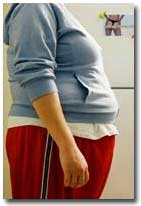
 In preparation for the upcoming weight management conferences in Europe, here is what we know about the value of herbals as an aid to weight loss.
Continue reading Herbal supplements for weight loss: What works, what doesn’t
In preparation for the upcoming weight management conferences in Europe, here is what we know about the value of herbals as an aid to weight loss.
Continue reading Herbal supplements for weight loss: What works, what doesn’t
 The National Institute of Standards and Technology (NIST) has issued Standard Reference Materials (SRMs) for Ginkgo biloba.
The NIST reference materials will help researchers validate the accuracy of measurements for flavonoids and terpene lactones (plant constituents associated with the effectiveness of ginkgo) as well as toxic elements in ginkgo. Continue reading Essential tools improve the quality of Ginkgo biloba research
 In 2003, Professor Edzard Ernst writing on the Cochrane Collaboration website concluded, “Compared with placebo, kava extract is an effective symptomatic treatment for anxiety although, at present, the size of the effect seems small.” Continue reading A critical review of herbals to treat anxiety and depression
 These recommendations, from a group of experts, take a narrow view of Alzheimer’s disease. They focus on early detection and the use of existing prescription drugs.
That’s fine as far as it goes, but what about those with advanced Alzheimer’s? Why not develop a more comprehensive approach?
If I might quote Paul Harvey, “here’s the rest of the story.” Continue reading Dissapointing recommendations to treat Alzheimer’s disease
Research reported during the latest meeting of the American Society for Pharmacology and Experimental Therapeutics concludes that these herbals do not place people at risk for certain types of drug interactions.
Here are the details. Continue reading Reported lack of interaction between ginseng or ginkgo biloba and other drugs
Actually, they reviewed more than CAM, but that’s what will be covered here.
Continue reading British Association for Psychopharmacology rates CAM for dementia
 Vertigo is a dizzying sensation of tilting or being in tilting or spinning surroundings.
Vertigoheel is a homeopathic product. It contains Ambra grisea, Anamirta cocculus, Conium maculatum, and Petroleum rectificatum.
Recently, a review of its effectiveness was published.
These data are from a telephone survey of more than 2500 randomly sampled noninstitutionalized Americans, which was published in 2002. The tables can also be found here. Continue reading The most commonly used vitamins and herbals
Several herbal remedies and other dietary supplements are promoted as effective treatments for Alzheimer’s disease and related disorders. The Alzheimer’s Association summarizes the supporting data for the following treatments.
A review of ginkgo biloba is also available here.
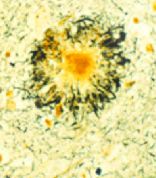
Illustration: Neurofibrillary tangles and fiberlike processes of neurons (black) surround an amyloid plaque. Source: Chemical and Engineering News
7/8/06 15:50 JR
The problem with available prescription drugs used to treat Alzheimer’s disease is that none of them reverse the process of dementia. This graph showing the response during treatment with Aricept (donepezil) is typical (see figure 1). Following initial improvement, the response to active treatments as well as placebo declines. Following discontinuation, the level of dementia rapidly declines (gets worse) until drug-treated patients and placebo-treated patients are about the same. Continue reading Status of ginkgo to treat Alzheimer’s disease
In a video taped editorial, Dr. Wallace Sampson complains that the NCCAM on its website, “links to trade and unscientific occupational organizations, and presents anomalous methods in a ‘neutral’ light.” Furthermore, Dr. Wallace states, “It contains minimal cautionary, negative information.” This is all the more disturbing because we expect more from a government-sponsored information resource.
The NCCAM counters “while some scientific evidence exists regarding some CAM therapies, for most there are key questions that are yet to be answered through well-designed scientific studies, questions such as whether these therapies are safe and whether they work for the diseases or medical conditions for which they are used.”
As a clinical professor of medicine (emeritus) at Stanford University, and editor of The Scientific Review of Alternative Medicine, Dr. Sampson’s assessment must not be dismissed. Is it reasonable to expect that studies of CAM be as well designed as those of conventional medicine? I think so.
NCCAM provides a useful service in making CAM data available, but studies of ginseng, Ginkgo biloba, garlic supplements, coffee enemas, and glucosamine, for example, should be held to high study design standards.