Court suppresses report on herbal treatment of tinnitus

In April 2006 Schwabe Pharma (Australia) launched a marketing campaign promoting Tebonin for “tinnitus and vertigo relief.” Tebonin is an extract of Ginkgo biloba leaves called EGB761.

Now, the British Medical Journal reports that a federal court in Australia has granted an injunction sought by the company to temporarily suppress a report by a consumer watchdog group called AusPharm Consumer Health Watch that is critical of this product.

The advertisement for Tebonin states that it has shown “through clinical research to be an effective treatment for a range of conditions relating to microcirculation including tinnitus, vertigo, peripheral circulation and cognitive function.”

It continues, “Tebonin optimizes the flow properties of the blood through capillaries increasing the amount of oxygen supplied to all organs, tissues and individual cells throughout the human body, effectively reducing the amount of free radicals within cells and enabling optimum cell function.”

A detailed review published in The Journal of the American Botanical Association makes no mention of EGB research on tinnitus or vertigo.

7/13/06 21:36 JR

Ketogenic diet for seizure control

Among patients with epilepsy who follow a ketogenic diet, complete seizure control after two years of treatment is achieved in 24%, while a 90% reduction in seizures is achieved in 52%. In other words, the reward for being able to tolerate this stringent, mathematically calculated diet that is high in fat and low in protein and carbohydrates is at least a 90% reduction in seizures in 3 out of 4 patients. These findings are part of a meta-analysis of 19 clinical trials of more than 1000 patients.

This is even more impressive when one considers that candidates for the diet are generally young children with medically intractable generalized seizures. It’s not easy. About 50% of patients drop out of the diet over time. The main reason given is that the diet was not effective. Other reasons include complaints that the diet is too restrictive, intolerability due to side effects, or just poor compliance that makes the effort not worthwhile.

The children and their parents and caregivers who stay with the effort deserve credit for their persistence and commitment, especially since the response is not immediate.

For more information on how the ketogenic diet works, go here. A good introduction is available here.

7/13/06 09:35 JR

Acupuncture: Does it matter where the needles go?

More than 1000 patients with chronic pain for at least 6 months due to osteoarthritis of the knee received up to 6 physiotherapy sessions and as-needed anti-inflammatory drugs. In addition, they were randomly assigned to receive 10 sessions of traditional Chinese acupuncture (TCA) or sham acupuncture from experienced acupuncture therapists, or 10 physician visits within 6 weeks.

The inclusion of acupuncture led to greater improvement in Western Ontario and McMaster Universities Osteoarthritis Index (WOMAC) scores and physical functioning at 26 weeks.

But here is the point. (Sorry, I couldn’t help my self.) There was no significant difference in improvement between TCA and sham acupuncture. The researchers concluded that one explanation for the lack of any observed differences could be the physiologic effect of needling regardless of whether it is done according to TCA principles. Further analysis is provided here.

7/11/06 23:03 JR

Expansion of CAM education in medical school curricula

In 1995 the Alternative Medicine Interest Group of the Society of Teachers of Family Medicine surveyed U.S. medical school departments of family medicine and all family medicine residency programs to determine the extent to which CAM was being taught in medical schools.

The results of this survey and two others are summarized here.

  • 1995: CAM was taught in 34% of U.S. medical schools and 28% of family practice residency programs.
  • 1996-1997 academic year: The number of medical schools offering courses on CAM-related topics rose from 45 of 125 (36%) schools
  • 1998: 75 of 125 (60%) schools
  • 2002-2003 academic year: 98 out of 126 (78%) medical schools offered courses in CAM.

Are we detecting a trend here?

7/10/06 20:57 JR

Music therapy for Alzheimer’s disease

I am usually disappointed when I read descriptions of music therapy and the job description of a music therapist. For example, The American Music Therapy Association defines music therapy as “clinical and evidence-based use of music interventions to accomplish individualized goals within a therapeutic relationship by a credentialed professional who has completed an approved music therapy program.”

What does that mean, exactly? I want to know what actually changes when music therapy is included in patient care? To find out, I searched PubMed for all articles on “music therapy” published in 2006. I found two articles that help me understand what to expect, here in post cardiac surgery patients, and here in patients with Alzheimer’s disease. The second study is especially clinically relevant.

Continue reading Music therapy for Alzheimer’s disease →

Music therapy conference

The 2006 annual conference of the American Music Therapy Association will be held in my favorite city, Kansas City, Missouri, at the Kansas City Marriott Downtown.

It will cover the latest in music therapy trends and techniques.

The Opening Session begins November 16, 2006. Meetings begin November 14th.

7/10/06 10:56 JR

Coffee drinking and diabetes

The results of two studies indicate that coffee drinking reduces the risk of type 2 diabetes.

In the most recent publication, coffee intake, especially decaffeinated, was inversely associated with the risk of type 2 diabetes mellitus. The study was conducted in a group of more than 28,000 postmenopausal women, with no evidence of diabetes or heart disease at the start of the study, who were followed for 11 years. When compared with women who did not drink coffee, those who consumed 6 or more cups per day had a 22% lower risk of diabetes.

These results support an earlier study of more than 17,000 Dutch men and women where those who drank at least 7 cups of coffee each day had half the risk of developing type 2 diabetes compared with those who drank 2 cups per day.

Let’s place these results in perspective. Six cups of coffee is a lot of coffee. Coffee drinking is also associated with higher cholesterol levels, increased risk of heart disease, and rheumatoid arthritis.

As an alternative, walking briskly for 30 minutes five times a week can reduce your risk of developing diabetes by half. In addition, eating smaller, more frequent meals, with emphasis on foods that break down slowly, also slows the progression to diabetes.

Illustration: Just Coffee

7/9/06 22:24 JR

Chinese medicine gaining credibility in the U.S.

The San Francisco Chronicle published an article last week on the integration of Chinese medicine (eg, acupuncture, tai chi chuan, meditation and others) into Western healthcare institutions. The American Hospital Association states that 20% of the nation’s hospitals offered complementary medical services in 2004 ? more than double the number in 1998. Continue reading Chinese medicine gaining credibility in the U.S. →

Salt water to treat cystic fibrosis

The Blogs are abuzz today with talk of nebulized hypertonic saline to treat cystic fibrosis (CF). Glenn Reynolds at Instapundit has a comment and links to Dean Barnett of SoxBlog who reports his experience with saline from a patient’s perspective. The historical perspective on the treatment is interesting as well.

Saline is not new therapy, but it has assumed a higher profile since publication of a study in The New England Journal of Medicine early this year. The authors concluded, “Hypertonic saline preceded by a bronchodilator is an inexpensive, safe, and effective additional therapy for patients with cystic fibrosis.” The accompanying editorial (summarized on Medscape) was less impressed.

Recently, the Cochrane Collaboration reviewed the results of nine trials of nebulized hypertonic saline for CF. The reviewers concluded it “improves mucociliary clearance in short-term clinical trials and appears to increase lung function compared to control.” However, “In comparison to recombinant deoxyribonuclease it may be less effective at improving lung function after three months.”

Maybe so, but Dean’s perspective is encouraging. “This seems like if not a miracle, something damn close to it. For years good people, the world’s best, have been pouring their hearts, souls and money into finding effective treatments for CF and generally coming up with very little. And all of a sudden, a super-promising new treatment comes along. And it’s salt water!”

7/9/06 09:56 JR

CAM options to treat Alzheimer’s disease

Several herbal remedies and other dietary supplements are promoted as effective treatments for Alzheimer’s disease and related disorders. The Alzheimer’s Association summarizes the supporting data for the following treatments.

  • Coenzyme Q10
  • Ginkgo biloba
  • Huperzine A
  • Phosphatidylserine
  • Coral calcium

A review of ginkgo biloba is also available here.

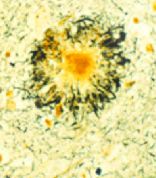
Illustration: Neurofibrillary tangles and fiberlike processes of neurons (black) surround an amyloid plaque. Source: Chemical and Engineering News

7/8/06 15:50 JR

Status of ginkgo to treat Alzheimer’s disease

The problem with available prescription drugs used to treat Alzheimer’s disease is that none of them reverse the process of dementia. This graph showing the response during treatment with Aricept (donepezil) is typical (see figure 1). Following initial improvement, the response to active treatments as well as placebo declines. Following discontinuation, the level of dementia rapidly declines (gets worse) until drug-treated patients and placebo-treated patients are about the same. Continue reading Status of ginkgo to treat Alzheimer’s disease →

The coming change in trans fats

When Statistics Canada asked 35,000 people what they ate in the past 24 hours, pizza, donuts, subs and burgers were the staples of the great Canadian diet. I’m no better. I love french fries. My biggest complaint is that I can’t get enough ketchup on them.

The health risks associated with fries are worse here in New York, where McDonald’s ranks highest for trans fats. Fortunately, change is coming to the fast food industry; lead by Wendy’s, which recently committed to banning the use of trans fats in their cooking. (Check with you local outlet to see if they are complying.)

Other good news.

  • A Chicago aldermen wants the city become the first in the nation to ban restaurants from using trans fats
  • Panera Bread has reformulated recipes to make its menu nearly trans-fat free

The FDA says, “Scientific evidence shows that consumption of saturated fat, trans fat, and dietary cholesterol raises low-density lipoprotein (LDL), or “bad” cholesterol, levels, which increases the risk of coronary heart disease (CHD).”

This FDA website has a useful table comparing the fat content (including trans fats) of selected foods. There is also a pie chart on the main sources of trans fats in our diets.

Want to lean more? You can register at this Google link to get updates on trans fats.

7/8/06 11:22 JR

Natural Standard: The Authority on Integrative Medicine

While searching the Internet I came across the Natural Standard website. Natural Standard is an “international research collaboration that aggregates and synthesizes data on complementary and alternative therapies.”

I spoke with a representative who gave me a tour of the site, which requires a subscription for access. Not cheap, but based on what I saw, it is an extensive and well documented resource.

There is also a free monthly newsletter.

7/7/0610:46 JR

The cutting edge of antioxidant therapy

Silvia Muro Galindo, PhD, is a research assistant professor of pharmacology at the University of Pennsylvania. Her research is designed to increase the amount of therapeutic enzymes that reach the interior of cells by targeting the enzymes to specific sites on the cell surface. She does this by working with features on the enzyme delivery vehicle as well as those on the surface of targeted cells.

According to Dr. Galindo, “Understanding such interactions between drug delivery vehicles and the target cells brings crucial information towards the optimization of intracellular delivery of therapeutics and the duration of their effects.” The potential benefits of this research for healthcare include more precise therapy at lower doses with a lower risk of side effects.

She is not alone in this quest. For example, researchers are targeting antioxidant enzymes to treat brain tumors. Others are targeting antioxidants to decrease the complications of cardiac surgery. Just two examples of the many areas of targeted antioxdant therapeutics being researched today.

7/7/06 08:27 JR

Acupuncture as effective long-term pain control

A 2003 technology assessment by the U.S. Department of Health and Human Services concluded, “The currently available evidence is insufficient to determine whether acupuncture has a specific beneficial effect in osteoarthritis.”

Since then, two studies reported benefits with acupuncture in patients with osteoarthritis of the knee. In the first study, 570 patients were treated for 26 weeks. Those treated with true acupuncture experienced significantly greater improvement as measured by the Western Ontario and McMaster Universities Osteoarthritis Index (WOMAC) pain and function scores at 8 weeks and 26 weeks vs. those treated with sham acupuncture.

In the second study, 294 patients were assigned to 8 weeks of acupuncture, minimal acupuncture (superficial needling at non-acupuncture points), or an education control group. Pain and joint function measured by WOMAC improved significantly with acupuncture vs. the other treatments at the end of 8 weeks. However, the benefits decreased over time, with no difference between groups at 52 weeks.

Thus, the quandary. Chronic acupuncture treatments are expensive. How do we maintain the benefit of acupuncture over the long term? Is it possible that acupuncture can be self-administered successfully? The results of a retrospective audit of 52 patients who had a positive response to acupuncture previously found that 8 out of 10 patients continued to have pain reduction with self-acupuncture. Quality of life was also improved, and no serious adverse effects were reported.

The investigators concluded that self-acupuncture has considerable potential to reduce clinic waiting lists and appointment times for patients.

One would anticipate cost savings as well.

7/3/06 22:22 JR

Expos and association meetings

If you needed an excuse to visit the Inner Harbor, you’ve got it. The Natural Products Expo East is scheduled to take place in Baltimore from October 4 to 7, 2006 at the Baltimore Convention Center. Features will include everyting from the Organic Harvest Festival all the way to Pure Decadence. While you are there be sure to see the rebuilt B&O Railroad museum.

On the other side of the globe, the Natural Products Expo Japan will be held on September 21 to 23 in Tokyo at the International Exhibition Center. Set aside time to ride the high speed Shinkansen to Kyoto for a day.

On the west coast? No problem. The American Asociation of Naturopathic Physicians annual meeting will be held in Portland, Oregon on August 9 to 12 at the Portland Oregon Convention Center. Never been to Portland, but the timning is good, as the rainy season runs from October through May.

6/27/06 22:29 JR

Vitamin C, antioxidants, and cancer treatment

Just in time for the berry harvest, two articles published on Friday (6/13/06) revisit vitamin C and antioxidants and their role in the treatment or prevention of cancer. The MSNBC “feel good” article is about vitamin C and antioxidants such as ellagic acid and pterostilbene, which are found in berries. “Do normal portions of berries give us enough phytochemicals to get protective benefits?” After 9 paragraphs the author discloses that we just don’t know, and ? you guessed it ? “more research is needed”.

On the same day, the Kansas City Star published an article that wondered if the two government-sponsored studies intended to test the claims of Linus Pauling, the Nobel laureate-turned-vitamin C advocate, might have succeeded if vitamin C had been administered directly into the vein rather than taken by mouth.

Not sure how this applies to berries bought at Stop & Shop, but at least we are reassured that more research on vitamin C is ongoing.

It has been three decades since Dr. Pauling and his collaborators first reported (first 4 citations listed here) beneficial effects of high-dose vitamin C (ascorbic acid) therapy for patients with terminal cancer. It might be another 30 years before we can say that research has clarified its role.

Until then, I’ll have strawberries on my corn flakes, please, because I like them and not because the antioxidants they contain make them an unsung cancer weapon.

6/26/06 18:14 JR

Complementary and Alternative Medicine: Fair, Balanced, and to the Point