Results from a recent survey suggest that the profile of the typical consumer of natural, organic and health products (NOHPs; pronounced “nopes”) is coming closer to mainstream America.
Factors leading people to select CAM therapies
It’s time to stop thinking of CAM as a homogeneous alternative to conventional medicine. Approximately 40% of the U.S. population use some form of CAM. In addition to studying the efficacy of CAM therapies, it’s time to assess individual CAM options from a socio-economic perspective.
Continue reading Factors leading people to select CAM therapies
Green tea lowers the risk of breast cancer
 About a year ago, the U.S. Food and Drug Administration (FDA) issued a statement that based on available data, “it is highly unlikely that green tea reduces the risk of breast cancer.” This conclusion was based on two studies in which drinking green tea did not reduce the risk of breast cancer in women, and one weaker, more limited study where drinking green tea might reduce this risk.
Now, a year later, there is another review and a different conclusion by researchers at the University of Minnesota.
Pomegranate and PSA in prostate cancer
 The first clinical trial of pomegranate juice in patients with prostate cancer reported a “significant prolongation of PSA [prostate-specific antigen] doubling time” from 15 to 54 months among men with a rising PSA following surgery or radiation for prostate cancer. This was accompanied by other positive changes at the cellular level, according to the researchers from the David Geffen School of Medicine in the July issue of Clinical Cancer Research.
Mediterranean diet lowers the risk of Alzheimer’s disease
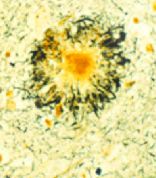 Following a Mediterranean-type diet lowers the risk of cardiac death and nonfatal heart attacks, as well as stroke and pulmonary embolism. More background on the diet is available here.
Now, a study published in the Annals of Neurology reports that “higher adherence to the Mediterranean diet is associated with a reduction in risk for Alzheimer’s disease.”
Continue reading Mediterranean diet lowers the risk of Alzheimer’s disease
More criticism of NCCAM
 Earlier this year a study published in The New England Journal of Medicine reported, “saw palmetto did not improve symptoms or objective measures of benign prostatic hyperplasia.” The results were interesting in light of the fact that the weight of the medical literature supports the value of saw palmetto for this condition.
CAM use among women with breast cancer
The use of CAM is widespread in this group of patients. The Oregon Health Sciences University in Portland reports between 66% and 84% ? the majority of whom use CAM without a recommendation from their doctor.
The most common reasons for the use of CAM among women with breast cancer is to reduce the symptoms of psychological distress. Whereas, the lowest frequency of CAM use is associated with dissatisfaction with traditional medical care.
Relaxation/meditation, herbs, spiritual healing, nutritional supplements, and megavitamins were also mentioned by the patients in these surveys.
Based on an earlier post, perhaps CAM should be considered in the early post operative phase or even presurgery.
7/30/06 16:09 JR
CAMophobia at NEJM
The New England Journal of Medicine published an article in 1999 that made an erroneous association between poorer psychological outcomes in women post breast cancer surgery and their use of CAM.
Here’s the summary quote (my italics). Note the emphasis in the NEJM study on assessment before surgery, while others focus on post surgical assessment results.
“Mental health scores were similar at base line among women who decided to use alternative medicine and those who did not, but three months after surgery the use of alternative medicine was independently associated with depression, fear of recurrence of cancer, lower scores for mental health and sexual satisfaction, and more physical symptoms as well as symptoms of greater intensity.”
The problem with the study was that these 480 patients with newly diagnosed early-stage breast cancer were recruited from a Massachusetts statewide cohort of women participating in a study of how women choose treatment for cancer.
Even back then it was recognized that the response to surgery varies among women. Some experience a strong sense of loss and need time to grieve. Others need time to adjust to an altered body image. Many patients feel a sense of relief following surgery, but worries about the long-term prognosis and follow-up therapy can cause added anxiety.
More recently, investigators found that the process of “denial coping” following surgery is a powerful predictor of future health fears. They concluded that there is a need to identify the interventions that can decrease this denial, and whether this then decreases health fears in the aftermath of breast cancer surgery.
7/30/06 16:44 JR
Unintended consequences: treating iron deficiency leads to feminism
 Here, from California Medicine Man via Instapundit, is one of the most important advances in medicine. Continue reading Unintended consequences: treating iron deficiency leads to feminism
Who is Matthias Rath, and why is he in trouble with the law?
 The trial of alternative medicine practitioner Dr. Matthias Rath started last week in Hamburg. Dr. Rath advocates a vitamin treatment to cure cancer. In this case a 9-year-old boy with bone cancer died after he [Dr. Rath] convinced the boy’s parents to use a “miracle cure” rich in vitamins and to reject conventional medical treatments.
The child’s mother, Anke Feld, tells a bizarre story of conspiracy among physicians, conventional medicine, and the pharmaceutical industry in which her son was a pawn. She believes her son “died as a result of the numerous clinical and medical errors and the negligence with which our son was treated in the different hospitals.”
Dr. Rath, whom Ms. Feld thanks for his support and guidance, is the founder of Cellular Medicine, which his website describes as a groundbreaking concept that identifies nutritional deficiencies at the cellular level as a root cause of many chronic diseases. A critical view of him is provided here.
7/28/06 15:32 JR
New sunscreen will be available this fall
The Food and Drug Administration approved Anthelios SX today. It is a moisturizer and sun blocker from L’Oreal.
Anthelios SX will contains avobenzone (blocks UVA) and octocrylenem (blocks UVB). Both ingredients are already found in sunscreens sold in the U.S. What’s new about Anthelios SX is that it will also contain ecamsule, which blocks short UVA and has not previously been sold in the U.S. Ecamsule has been marketed in Europe and Canada as Mexoryl SX since 1993.
UVA rays account for approximately 95% of all ultraviolet energy. They can cause permanent damage to DNA. UVA passes through glass, and the effects do not show right away. By comparison, UVB rays cause sunburn but do not penetrate as deeply as UVA rays.
The product will be available in the fall, just in time for ski season.
7/24/06 15:03 JR
Follow-up: Becoming trans fat free
 Earlier this month this site discussed trans fats, including the initiative to make Chicago the first major city in the country to go trans fat free. Now, The New York Times has published an article on alderman Edward Burke and his proposal.
Chicago’s representatives are a “progressive” lot. They forbid restaurants from selling foie gras and may force cabbies to dress better. However, one major obstacle stands in the way. Mayor Richard Daley thinks it’s one rule too many. With such formidable opposition, Mr. Burke’s proposal may languish.
If you have an opinion contact the mayor at his office via facsimile: 312-744-8045. Or, send an email.
7/23/06 09:35 JR
Biofeedback and functional constipation
 Medscape has a summary of presentations from this year’s Digestive Disease Week (DDW) meeting, which is the world’s largest gathering of physicians and researchers who specialize in diseases of the intestines and liver.
One presentation looked at the role of biofeedback in patients with functional constipation. Among 60 patients studied, the group treated with biofeedback had a significant reduction in straining, feelings of incomplete evacuation, bloating, and laxative use.
Functional constipation, also known as chronic idiopathic constipation, is a rare condition that occurs most often in women and may be related to problems in hormone function or with nerves and muscles in the colon, rectum, or anus.
7/20/06 10:29 JR
Not your typical vacation
Do you have vacation time coming in 2006? Herbalgram.org has listed the 2006 events calendar. Rather than the same Caribbean vacation or week at the Jersey shore, consider linking your vacation to a CAM meeting.
Here’s one that makes my tastebuds tingle.
July 30-Aug 5: Wild Foods Mountain Retreat. A week-long program in Virginia’s Blue Ridge Mountains. Forage for wild edible and medicinal plants, and prepare tasty and nutritional meals.
Hmm, Hmm, Hmm.
Other must attend meetings.
October 16-17: First International Symposium on Pomegranate and Minor Mediterranean Fruits. Adana, Turkey.
or
October 28-30: The 2nd Internatiomal Symposium on Saffron Biology and Technology (ISSBT). Mashhad, Iran.
Do you think CAM is becoming too specialized?
Want to see more? Go to the Herbalgram.org website.
7/18/06 13:20 JR
You can use it, but I own it.
 ? Copyright ? 2006, The MedCom Resource, Inc. www.MedComRes.com
Wyeth questions the role of pharmacists to compound HRT
 In April, Wyeth Labs renewed its request (submitted last October) for increased FDA regulation of compounding pharmacies that prepare hormone replacement therapy (HRT). Wyeth markets the HRT called Premarin and asserts that the HRT medicines prepared by compounding pharmacies can pose serious health risks.
Here is some historical perspective. Prior to the 1950s, when commercially prepared drugs became widely available, compounding prescriptions to be taken by mouth or inserted rectally was the main function of community pharmacists. In fact, as late as the 1970s (at least in New Jersey), compounding was part of the licensing exam for pharmacists.
In the 1970s, with the advent of total parenteral nutrition, preparation (compounding) of injectables increased by hospital pharmacists. In the 1980s there was a resurgence of compounding in community pharmacies.
In an excellent review, Dr. David Newton states, “Since the early 1990s, most national pharmacy practitioner organizations have asserted compounding is an intrinsic professional practice to be regulated by state boards of pharmacy.” The FDA usually defers to state boards to oversee this practice. Yet, state boards lack inspectors to enforce compounding practice standards, and most boards of pharmacy do not examine the compounding proficiency of their licensure candidates.
The implications of Wyeth’s anticompetitive petition according to the International Association of Compounding Pharmacists, is the “end to the option of prescribing bio-identical hormone replacement therapy for those patients that need it.”
The FDA is reviewing Wyeth’s request.
7/16/06 10:40 JR
Consumer alert: Conting Qianweisu Slimming Herbs Capsule
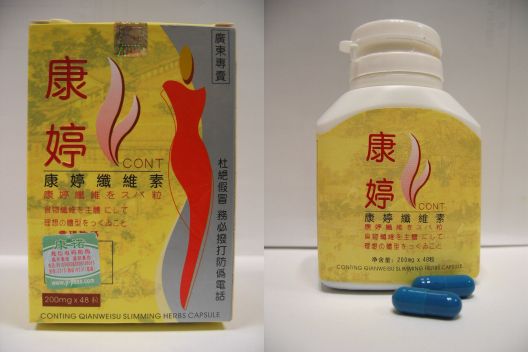 Just got back from vacation? Did you enjoy your trip to Hong Kong? What’s that you say, you found a great diet pill there that you put in your suitcase and took home?
It’s called what? “Conting Qianweisu Slimming Herbs Capsule”?
Hmm, catchy name. Caution!
Continue reading Consumer alert: Conting Qianweisu Slimming Herbs Capsule
Lack of a direct association between marijuana and lung cancer
A newly published review in the Archives of Internal Medicine confirms what has been known since 1988. Epidemiological and clinical data do not show a direct cause and effect relationship between marijuana smoking and the development of lung cancer.
Possible reasons that studies detect lung damage but not cancer in marijuana smokers include the young age of the smokers studied, the small number of people included in each study, and the lack of long-term monitoring.
What was found in marijuana smokers included the following:
- The lungs are exposed to tar (the solid residue of tobacco smoke containing byproducts of combustion)
- The macrophage cells in the alveoli (the oxygen exchange cells) that should protect against noxious substances do not work properly
- There is increased oxidative stress
- Cells in the bronchi (the air passages) show an increase in abnormal and precancerous findings
Since some bronchial cell changes appear to be precancerous, an increased risk of cancer among frequent marijuana smokers is possible.
7/15/06 14:20 JR
Cannabis club banned at Fisherman’s Warf
This site reported previously about the growing resistance to medical cannabis clubs in San Francisco. Apparently, it is having an effect.
Now, The New York Times reports, “Marijuana cannot be sold alongside the cracked crab and souvenirs of Fisherman?s Wharf, the San Francisco Planning Commission decided late Thursday.” One commissioner stated, “the neighborhood was adamantly opposed to the dispensary?.
The cracked crabs will appeal.
7/14/06 09:30 JR
When is a side effect not a side effect?
Cultures around the world differ in what is considered a side effect (SE) that is important enough to report to a doctor during treatment or by a researcher during a clinical trial. Here are first-hand examples of what I mean. At the end I’ll explain why these differences are important.
SEs in Germany: The diabetes drug Precose (acarbose) was first tested in Germany, then marketed in Japan, and finally tested and marketed in the U.S. My first experience was in writing articles about Precose for Japanese doctors.
The German data indicated that flatulence was a known SE, but not a major problem. Yet, when it was finally studied and marketed in the U.S., flatulence was so severe that it prevented most people from taking Precose for any length of time.
Frustrated, the U.S. product manager eventually asked his German counterparts why their data never identified flatulence as a serious problem. They answered that in German trials, reported SEs came from patients who completed a study. Well, of course these were patients not bothered by flatulence, and thus the reported incidence was low. It ignored all patients in Germany who discontinued treatment because of SEs, such as flatulence.
SEs in the U.S.: U.S. studies report SEs on all patients who participate even for one dose. Therefore, there is likely to be a discrepancy between what is reported in a U.S. vs. German clinical trial. (My experience goes back more than 10 years, and it is possible that German clinical trial design has changed since then.)
SEs in Japan: My experience in obtaining SE data from Japanese studies is based on experience with photodynamic therapy. At the request of the U.S. Food and Drug Administration, a company sent me to Japan to collect safety data on this treatment. To my surprise, Japanese research reports listed almost no SEs. I later learned that Japanese patients were loath to report SEs to their doctors, because it was a sign of disrespect. Well, semasen goziemas, as Steve Martin used to say.
In a previous post I reported the position of the World Health Organization regarding the safety of herbals. I hope this explains why we should be dubious of this position.
7/14/06 14:18 JR