In an earlier post, women complained that they did not know the proper dose of soy-containing products to treat the symptoms of menopause, and had low confidence in the ability of healthcare professionals to provide this information.
I received some emails promoting Nature Made CholestOff. It contains plant extracts called phytonutrients, specifically phytosterols and phytostanols. They work by reducing the absorption of LDL “bad” cholesterol and total cholesterol from the intestines.
Researchers from the Medical University of Vienna reviewed and reanalyzed the results from 25 studies of the treatment of the climacteric syndrome (menopause).
Using soy foods to replace foods high in animal protein that contain fat and cholesterol might help improve cholesterol levels and confer benefits to cardiovascular health in postmenopausal women.
Lipids Online has a good summary of a study just published in the journal, Menopause.
A quick Google search (“soy” and “blood pressure”) reveals the predominant view that soy has positive effects on the heart and significant (but mild) blood pressure lowering action in people with high blood pressure.
Previous studies on the effect of soy isoflavones on bone health have been disappointing. So, a positive response to soy isoflavones on the bone mineral density (BMD) of the lumbar spine and femoral neck is of interest.
A review of 13 randomized controlled studies reported, “supplementation with phytonadione and menaquinone-4 reduces bone loss. In the case of the latter, there’s a strong effect on incident fractures among Japanese patients.”
Two studies published this year came to different conclusions on the value of soy isoflavones to prevent bone resorption (breakdown) in postmenopausal women.
Omega-3 fatty acids benefit the heart of healthy people, and those who are at high risk of heart disease or already have it. And I suppose when it becomes a prescription drug, it’s no longer complementary but integrated into mainstream medicine.
Adriane Fugh-Berman, associate professor in the complementary medicine program at Georgetown University has chronicled the lack of good treatment alternatives for hot flashes.
My anecdotal experience is that soy gives me a headache. Not from eating it, but from reading about it!
Too much about soy sources, the fermentation processes, and oh those isoflavones. Way too much bloviating here, here, and here about the pros and cons of soy.
Sometimes you just have to cut through the fog and ask, What’s the bottom line on soy?
Thanks to a Washington state food market chain, here it is.
 In an earlier post, women complained that they did not know the proper dose of soy-containing products to treat the symptoms of menopause, and had low confidence in the ability of healthcare professionals to provide this information.
 Almost all supplements tested in this
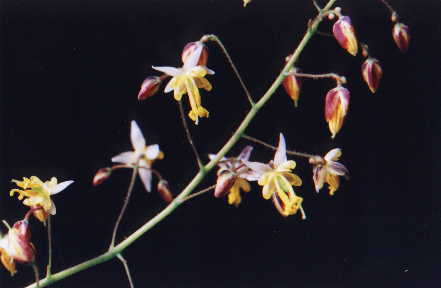 Horny goat weed, also known as epimedium and yin yan huo, is a source of phytoestrogens.
 I received some emails promoting Nature Made CholestOff. It contains plant extracts called phytonutrients, specifically phytosterols and phytostanols. They work by reducing the absorption of LDL “bad” cholesterol and total cholesterol from the intestines.
 Using soy foods to replace foods high in animal protein that contain fat and cholesterol might help improve cholesterol levels and confer benefits to cardiovascular health in postmenopausal women.
 A quick Google search (“soy” and “blood pressure”) reveals the predominant view that soy has positive effects on the heart and significant (but mild) blood pressure lowering action in people with high blood pressure.
 A