Category Archives: J. CONDITIONS TO TREAT

Dust mites, dietary fats, and asthma in children

What is the value in avoiding dust mites and increasing omega-3 fatty acids in a child’s diet — especially in children at high risk of developing asthma because of a family history? Lots of research has gone on down under to answer this question. It’s part of the CAPS trial (Childhood Asthma Prevention Study).

Here’s what we learned

Continue reading Dust mites, dietary fats, and asthma in children →

Impotence, the Metabolic Syndrome, and the Mediterranean diet

After just posting about the benefits of the Mediterranean diet for Alzheimer’s disease yesterday, imagine my surprise to wake up this morning to another study about the benefits of the Mediterranean diet … this time for erectile dysfunction in men with the metabolic syndrome.

Continue reading Impotence, the Metabolic Syndrome, and the Mediterranean diet →

Factors leading people to select CAM therapies

It’s time to stop thinking of CAM as a homogeneous alternative to conventional medicine. Approximately 40% of the U.S. population use some form of CAM. In addition to studying the efficacy of CAM therapies, it’s time to assess individual CAM options from a socio-economic perspective.

Continue reading Factors leading people to select CAM therapies →

Pomegranate and PSA in prostate cancer

The first clinical trial of pomegranate juice in patients with prostate cancer reported a “significant prolongation of PSA [prostate-specific antigen] doubling time” from 15 to 54 months among men with a rising PSA following surgery or radiation for prostate cancer. This was accompanied by other positive changes at the cellular level, according to the researchers from the David Geffen School of Medicine in the July issue of Clinical Cancer Research.

Continue reading Pomegranate and PSA in prostate cancer →

Mediterranean diet lowers the risk of Alzheimer’s disease

Following a Mediterranean-type diet lowers the risk of cardiac death and nonfatal heart attacks, as well as stroke and pulmonary embolism. More background on the diet is available here.

Now, a study published in the Annals of Neurology reports that “higher adherence to the Mediterranean diet is associated with a reduction in risk for Alzheimer’s disease.”

Continue reading Mediterranean diet lowers the risk of Alzheimer’s disease →

Who is Matthias Rath, and why is he in trouble with the law?

The trial of alternative medicine practitioner Dr. Matthias Rath started last week in Hamburg. Dr. Rath advocates a vitamin treatment to cure cancer. In this case a 9-year-old boy with bone cancer died after he [Dr. Rath] convinced the boy’s parents to use a “miracle cure” rich in vitamins and to reject conventional medical treatments.

The child’s mother, Anke Feld, tells a bizarre story of conspiracy among physicians, conventional medicine, and the pharmaceutical industry in which her son was a pawn. She believes her son “died as a result of the numerous clinical and medical errors and the negligence with which our son was treated in the different hospitals.”

Dr. Rath, whom Ms. Feld thanks for his support and guidance, is the founder of Cellular Medicine, which his website describes as a groundbreaking concept that identifies nutritional deficiencies at the cellular level as a root cause of many chronic diseases. A critical view of him is provided here.

7/28/06 15:32 JR

Lack of a direct association between marijuana and lung cancer

A newly published review in the Archives of Internal Medicine confirms what has been known since 1988. Epidemiological and clinical data do not show a direct cause and effect relationship between marijuana smoking and the development of lung cancer.

Possible reasons that studies detect lung damage but not cancer in marijuana smokers include the young age of the smokers studied, the small number of people included in each study, and the lack of long-term monitoring.

What was found in marijuana smokers included the following:

  • The lungs are exposed to tar (the solid residue of tobacco smoke containing byproducts of combustion)
  • The macrophage cells in the alveoli (the oxygen exchange cells) that should protect against noxious substances do not work properly
  • There is increased oxidative stress
  • Cells in the bronchi (the air passages) show an increase in abnormal and precancerous findings

Since some bronchial cell changes appear to be precancerous, an increased risk of cancer among frequent marijuana smokers is possible.

7/15/06 14:20 JR

Court suppresses report on herbal treatment of tinnitus

In April 2006 Schwabe Pharma (Australia) launched a marketing campaign promoting Tebonin for “tinnitus and vertigo relief.” Tebonin is an extract of Ginkgo biloba leaves called EGB761.

Now, the British Medical Journal reports that a federal court in Australia has granted an injunction sought by the company to temporarily suppress a report by a consumer watchdog group called AusPharm Consumer Health Watch that is critical of this product.

The advertisement for Tebonin states that it has shown “through clinical research to be an effective treatment for a range of conditions relating to microcirculation including tinnitus, vertigo, peripheral circulation and cognitive function.”

It continues, “Tebonin optimizes the flow properties of the blood through capillaries increasing the amount of oxygen supplied to all organs, tissues and individual cells throughout the human body, effectively reducing the amount of free radicals within cells and enabling optimum cell function.”

A detailed review published in The Journal of the American Botanical Association makes no mention of EGB research on tinnitus or vertigo.

7/13/06 21:36 JR

Ketogenic diet for seizure control

Among patients with epilepsy who follow a ketogenic diet, complete seizure control after two years of treatment is achieved in 24%, while a 90% reduction in seizures is achieved in 52%. In other words, the reward for being able to tolerate this stringent, mathematically calculated diet that is high in fat and low in protein and carbohydrates is at least a 90% reduction in seizures in 3 out of 4 patients. These findings are part of a meta-analysis of 19 clinical trials of more than 1000 patients.

This is even more impressive when one considers that candidates for the diet are generally young children with medically intractable generalized seizures. It’s not easy. About 50% of patients drop out of the diet over time. The main reason given is that the diet was not effective. Other reasons include complaints that the diet is too restrictive, intolerability due to side effects, or just poor compliance that makes the effort not worthwhile.

The children and their parents and caregivers who stay with the effort deserve credit for their persistence and commitment, especially since the response is not immediate.

For more information on how the ketogenic diet works, go here. A good introduction is available here.

7/13/06 09:35 JR

Acupuncture: Does it matter where the needles go?

More than 1000 patients with chronic pain for at least 6 months due to osteoarthritis of the knee received up to 6 physiotherapy sessions and as-needed anti-inflammatory drugs. In addition, they were randomly assigned to receive 10 sessions of traditional Chinese acupuncture (TCA) or sham acupuncture from experienced acupuncture therapists, or 10 physician visits within 6 weeks.

The inclusion of acupuncture led to greater improvement in Western Ontario and McMaster Universities Osteoarthritis Index (WOMAC) scores and physical functioning at 26 weeks.

But here is the point. (Sorry, I couldn’t help my self.) There was no significant difference in improvement between TCA and sham acupuncture. The researchers concluded that one explanation for the lack of any observed differences could be the physiologic effect of needling regardless of whether it is done according to TCA principles. Further analysis is provided here.

7/11/06 23:03 JR

Music therapy for Alzheimer’s disease

I am usually disappointed when I read descriptions of music therapy and the job description of a music therapist. For example, The American Music Therapy Association defines music therapy as “clinical and evidence-based use of music interventions to accomplish individualized goals within a therapeutic relationship by a credentialed professional who has completed an approved music therapy program.”

What does that mean, exactly? I want to know what actually changes when music therapy is included in patient care? To find out, I searched PubMed for all articles on “music therapy” published in 2006. I found two articles that help me understand what to expect, here in post cardiac surgery patients, and here in patients with Alzheimer’s disease. The second study is especially clinically relevant.

Continue reading Music therapy for Alzheimer’s disease →

Coffee drinking and diabetes

The results of two studies indicate that coffee drinking reduces the risk of type 2 diabetes.

In the most recent publication, coffee intake, especially decaffeinated, was inversely associated with the risk of type 2 diabetes mellitus. The study was conducted in a group of more than 28,000 postmenopausal women, with no evidence of diabetes or heart disease at the start of the study, who were followed for 11 years. When compared with women who did not drink coffee, those who consumed 6 or more cups per day had a 22% lower risk of diabetes.

These results support an earlier study of more than 17,000 Dutch men and women where those who drank at least 7 cups of coffee each day had half the risk of developing type 2 diabetes compared with those who drank 2 cups per day.

Let’s place these results in perspective. Six cups of coffee is a lot of coffee. Coffee drinking is also associated with higher cholesterol levels, increased risk of heart disease, and rheumatoid arthritis.

As an alternative, walking briskly for 30 minutes five times a week can reduce your risk of developing diabetes by half. In addition, eating smaller, more frequent meals, with emphasis on foods that break down slowly, also slows the progression to diabetes.

Illustration: Just Coffee

7/9/06 22:24 JR

Salt water to treat cystic fibrosis

The Blogs are abuzz today with talk of nebulized hypertonic saline to treat cystic fibrosis (CF). Glenn Reynolds at Instapundit has a comment and links to Dean Barnett of SoxBlog who reports his experience with saline from a patient’s perspective. The historical perspective on the treatment is interesting as well.

Saline is not new therapy, but it has assumed a higher profile since publication of a study in The New England Journal of Medicine early this year. The authors concluded, “Hypertonic saline preceded by a bronchodilator is an inexpensive, safe, and effective additional therapy for patients with cystic fibrosis.” The accompanying editorial (summarized on Medscape) was less impressed.
Recently, the Cochrane Collaboration reviewed the results of nine trials of nebulized hypertonic saline for CF. The reviewers concluded it “improves mucociliary clearance in short-term clinical trials and appears to increase lung function compared to control.” However, “In comparison to recombinant deoxyribonuclease it may be less effective at improving lung function after three months.”

Maybe so, but Dean’s perspective is encouraging. “This seems like if not a miracle, something damn close to it. For years good people, the world’s best, have been pouring their hearts, souls and money into finding effective treatments for CF and generally coming up with very little. And all of a sudden, a super-promising new treatment comes along. And it’s salt water!”

7/9/06 09:56 JR

CAM options to treat Alzheimer’s disease

Several herbal remedies and other dietary supplements are promoted as effective treatments for Alzheimer’s disease and related disorders. The Alzheimer’s Association summarizes the supporting data for the following treatments.

  • Coenzyme Q10
  • Ginkgo biloba
  • Huperzine A
  • Phosphatidylserine
  • Coral calcium

A review of ginkgo biloba is also available here.

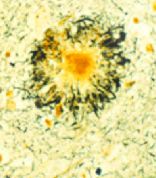
Illustration: Neurofibrillary tangles and fiberlike processes of neurons (black) surround an amyloid plaque. Source: Chemical and Engineering News

7/8/06 15:50 JR

Status of ginkgo to treat Alzheimer’s disease

The problem with available prescription drugs used to treat Alzheimer’s disease is that none of them reverse the process of dementia. This graph showing the response during treatment with Aricept (donepezil) is typical (see figure 1). Following initial improvement, the response to active treatments as well as placebo declines. Following discontinuation, the level of dementia rapidly declines (gets worse) until drug-treated patients and placebo-treated patients are about the same. Continue reading Status of ginkgo to treat Alzheimer’s disease →