 The first clinical trial of pomegranate juice in patients with prostate cancer reported a “significant prolongation of PSA [prostate-specific antigen] doubling time” from 15 to 54 months among men with a rising PSA following surgery or radiation for prostate cancer. This was accompanied by other positive changes at the cellular level, according to the researchers from the David Geffen School of Medicine in the July issue of Clinical Cancer Research.
Category Archives: E. DIETARY
Mediterranean diet lowers the risk of Alzheimer’s disease
 Following a Mediterranean-type diet lowers the risk of cardiac death and nonfatal heart attacks, as well as stroke and pulmonary embolism. More background on the diet is available here.
Now, a study published in the Annals of Neurology reports that “higher adherence to the Mediterranean diet is associated with a reduction in risk for Alzheimer’s disease.”
Continue reading Mediterranean diet lowers the risk of Alzheimer’s disease
Unintended consequences: treating iron deficiency leads to feminism
 Here, from California Medicine Man via Instapundit, is one of the most important advances in medicine. Continue reading Unintended consequences: treating iron deficiency leads to feminism
Follow-up: Becoming trans fat free
 Earlier this month this site discussed trans fats, including the initiative to make Chicago the first major city in the country to go trans fat free. Now, The New York Times has published an article on alderman Edward Burke and his proposal.
Chicago’s representatives are a “progressive” lot. They forbid restaurants from selling foie gras and may force cabbies to dress better. However, one major obstacle stands in the way. Mayor Richard Daley thinks it’s one rule too many. With such formidable opposition, Mr. Burke’s proposal may languish.
If you have an opinion contact the mayor at his office via facsimile: 312-744-8045. Or, send an email.
7/23/06 09:35 JR
Not your typical vacation
Do you have vacation time coming in 2006? Herbalgram.org has listed the 2006 events calendar. Rather than the same Caribbean vacation or week at the Jersey shore, consider linking your vacation to a CAM meeting.
Here’s one that makes my tastebuds tingle.
July 30-Aug 5: Wild Foods Mountain Retreat. A week-long program in Virginia’s Blue Ridge Mountains. Forage for wild edible and medicinal plants, and prepare tasty and nutritional meals.
Hmm, Hmm, Hmm.
Other must attend meetings.
October 16-17: First International Symposium on Pomegranate and Minor Mediterranean Fruits. Adana, Turkey.
or
October 28-30: The 2nd Internatiomal Symposium on Saffron Biology and Technology (ISSBT). Mashhad, Iran.
Do you think CAM is becoming too specialized?
Want to see more? Go to the Herbalgram.org website.
7/18/06 13:20 JR
Ketogenic diet for seizure control
Among patients with epilepsy who follow a ketogenic diet, complete seizure control after two years of treatment is achieved in 24%, while a 90% reduction in seizures is achieved in 52%. In other words, the reward for being able to tolerate this stringent, mathematically calculated diet that is high in fat and low in protein and carbohydrates is at least a 90% reduction in seizures in 3 out of 4 patients. These findings are part of a meta-analysis of 19 clinical trials of more than 1000 patients.
This is even more impressive when one considers that candidates for the diet are generally young children with medically intractable generalized seizures. It’s not easy. About 50% of patients drop out of the diet over time. The main reason given is that the diet was not effective. Other reasons include complaints that the diet is too restrictive, intolerability due to side effects, or just poor compliance that makes the effort not worthwhile.
The children and their parents and caregivers who stay with the effort deserve credit for their persistence and commitment, especially since the response is not immediate.
For more information on how the ketogenic diet works, go here. A good introduction is available here.
7/13/06 09:35 JR
Reversing neuropathic pain with diet and exercise
Exercise and diet can reduce neuropathic pain and help regenerate nerve fibers in overweight patients with impaired glucose tolerance (“Prediabetes”), according to research that was presented at the 2006 American Academy of Neurology 58th Annual Meeting.
Details of the study are reported here, and a review of the topic is presented here.
7/13/06 00:09 JR
Coffee drinking and diabetes
 The results of two studies indicate that coffee drinking reduces the risk of type 2 diabetes.
In the most recent publication, coffee intake, especially decaffeinated, was inversely associated with the risk of type 2 diabetes mellitus. The study was conducted in a group of more than 28,000 postmenopausal women, with no evidence of diabetes or heart disease at the start of the study, who were followed for 11 years. When compared with women who did not drink coffee, those who consumed 6 or more cups per day had a 22% lower risk of diabetes.
These results support an earlier study of more than 17,000 Dutch men and women where those who drank at least 7 cups of coffee each day had half the risk of developing type 2 diabetes compared with those who drank 2 cups per day.
Let’s place these results in perspective. Six cups of coffee is a lot of coffee. Coffee drinking is also associated with higher cholesterol levels, increased risk of heart disease, and rheumatoid arthritis.
As an alternative, walking briskly for 30 minutes five times a week can reduce your risk of developing diabetes by half. In addition, eating smaller, more frequent meals, with emphasis on foods that break down slowly, also slows the progression to diabetes.
Illustration: Just Coffee
7/9/06 22:24 JR
CAM options to treat Alzheimer’s disease
Several herbal remedies and other dietary supplements are promoted as effective treatments for Alzheimer’s disease and related disorders. The Alzheimer’s Association summarizes the supporting data for the following treatments.
- Coenzyme Q10
- Ginkgo biloba
- Huperzine A
- Phosphatidylserine
- Coral calcium
A review of ginkgo biloba is also available here.
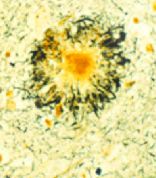
Illustration: Neurofibrillary tangles and fiberlike processes of neurons (black) surround an amyloid plaque. Source: Chemical and Engineering News
7/8/06 15:50 JR
The coming change in trans fats
When Statistics Canada asked 35,000 people what they ate in the past 24 hours, pizza, donuts, subs and burgers were the staples of the great Canadian diet. I’m no better. I love french fries. My biggest complaint is that I can’t get enough ketchup on them.
The health risks associated with fries are worse here in New York, where McDonald’s ranks highest for trans fats. Fortunately, change is coming to the fast food industry; lead by Wendy’s, which recently committed to banning the use of trans fats in their cooking. (Check with you local outlet to see if they are complying.)
Other good news.
- A Chicago aldermen wants the city become the first in the nation to ban restaurants from using trans fats
- Panera Bread has reformulated recipes to make its menu nearly trans-fat free
The FDA says, “Scientific evidence shows that consumption of saturated fat, trans fat, and dietary cholesterol raises low-density lipoprotein (LDL), or “bad” cholesterol, levels, which increases the risk of coronary heart disease (CHD).”
This FDA website has a useful table comparing the fat content (including trans fats) of selected foods. There is also a pie chart on the main sources of trans fats in our diets.
Want to lean more? You can register at this Google link to get updates on trans fats.
7/8/06 11:22 JR
Vitamin C, antioxidants, and cancer treatment
Just in time for the berry harvest, two articles published on Friday (6/13/06) revisit vitamin C and antioxidants and their role in the treatment or prevention of cancer. The MSNBC “feel good” article is about vitamin C and antioxidants such as ellagic acid and pterostilbene, which are found in berries. “Do normal portions of berries give us enough phytochemicals to get protective benefits?” After 9 paragraphs the author discloses that we just don’t know, and ? you guessed it ? “more research is needed”.
On the same day, the Kansas City Star published an article that wondered if the two government-sponsored studies intended to test the claims of Linus Pauling, the Nobel laureate-turned-vitamin C advocate, might have succeeded if vitamin C had been administered directly into the vein rather than taken by mouth.
Not sure how this applies to berries bought at Stop & Shop, but at least we are reassured that more research on vitamin C is ongoing.
It has been three decades since Dr. Pauling and his collaborators first reported (first 4 citations listed here) beneficial effects of high-dose vitamin C (ascorbic acid) therapy for patients with terminal cancer. It might be another 30 years before we can say that research has clarified its role.
Until then, I’ll have strawberries on my corn flakes, please, because I like them and not because the antioxidants they contain make them an unsung cancer weapon.
6/26/06 18:14 JR
National Center for Complementary and Alternative Medicine (NCCAM) criticized for bias
In a video taped editorial, Dr. Wallace Sampson complains that the NCCAM on its website, “links to trade and unscientific occupational organizations, and presents anomalous methods in a ‘neutral’ light.” Furthermore, Dr. Wallace states, “It contains minimal cautionary, negative information.” This is all the more disturbing because we expect more from a government-sponsored information resource.
The NCCAM counters “while some scientific evidence exists regarding some CAM therapies, for most there are key questions that are yet to be answered through well-designed scientific studies, questions such as whether these therapies are safe and whether they work for the diseases or medical conditions for which they are used.”
As a clinical professor of medicine (emeritus) at Stanford University, and editor of The Scientific Review of Alternative Medicine, Dr. Sampson’s assessment must not be dismissed. Is it reasonable to expect that studies of CAM be as well designed as those of conventional medicine? I think so.
NCCAM provides a useful service in making CAM data available, but studies of ginseng, Ginkgo biloba, garlic supplements, coffee enemas, and glucosamine, for example, should be held to high study design standards.
6/21/06 22:14 JR