The C.A.M. Report
Complementary and Alternative Medicine: Fair, Balanced, and to the Point
  • About this web log

    This blog is intended as an objective and dispassionate source of information on the latest CAM research. Since my background is in pharmacy and allopathic medicine, I view all CAM as advancing through the development pipeline to eventually become integrated into mainstream medical practice. Some will succeed while others fail. But all are treated fairly here.

  • About the author

    John Russo, Jr., PharmD, is president of The MedCom Resource, Inc. Previously, he was senior vice president of medical communications at www.Vicus.com, a complementary and alternative medicine website.

  • Top topics on The CAM Report

    *Animal-assisted Therapy
    *Birth Defects
    *Arsenic in modern medicine
    *Mindfulness and cognitive behavioral therapy
    *TENS/FNS/VNS

  • Recent Posts

  • Recent Comments

    • Common sense considerations

      The material on this weblog is for informational purposes. It is not medical advice or counsel. Be smart, consult your health professional before using CAM.

    • Support this site

      If you found the information here helpful, please consider supporting this site.If you found the information here helpful, please consider supporting this site.

    Vitamin D deficiency in older men
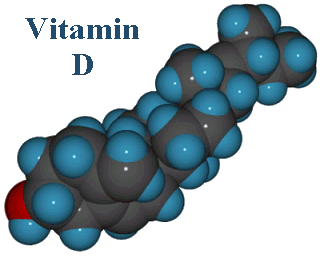
    This study was designed to determine the prevalence of vitamin D deficiency in older men.

    More interesting is the finding that taking vitamin D supplements didn’t help.

    First, the details.

    • Randomly selected older men from 6 US communities participated in the study.
    • Blood concentrations of 25-hydroxyvitamin D2 [25(OH)D2] and 25(OH)D3 were measured using mass spectrometry.

    And, the results.

    • Vitamin D deficiency (less than 20 ng/mL) was present in 26% of men.
    • Vitamin D insufficiency (less than 30 ng/mL) was present in 72% of men.
      • Optimal blood levels are between 20 to 60 mg/dL.
    • Deficiency was particularly common among men under the following conditions.
      • Winter and spring (especially in northern communities)
      • Older than 80 years old
      • Obese men (greater than 25 kg/m2)
    • 86% of men who didn’t engage in lawn/garden work, had a BMI greater than 25, and vitamin D intake below 400 IU/day had vitamin D deficiency.
    • The use of vitamin D supplements was reported by 58% of men, but had a small effect on total vitamin D levels.

    The bottom line?
    Vitamin D deficiency is common in older men, and taking supplements is of limited value.

    More about vitamin D is available at the Osteoporosis and Bone Physiology website.

    4/27/09 20:11 JR

    Leave a Comment

    You must be logged in to post a comment.

    Register Login